
What Is Shift Cover?
Shift cover is an external technician holding a scheduled shift for a set period. The technician holds a rota position, deals with whatever comes up on whichever machine, and hands over at the end. The scope is the shift.
Use shift cover when
- A named rota position is empty
- Work is reactive, cannot be scoped in advance
- You need presence across an area, not one machine
- Cover runs across consecutive shifts
Use a standard mission when
- One machine has one identifiable problem
- You want a specialist for defined work
- You want a report on one defined piece of work
- The fault can be diagnosed remotely first
Why an Uncovered Shift Is Expensive
An uncovered maintenance shift leaves two options, and both cost money. Run the line with nobody to respond, and any stoppage lasts until the next shift arrives. Or stop the line on purpose. In most plants an hour of unplanned downtime costs more than the technician who would have prevented it.
Work it out locally
- Take your hourly contribution margin on the affected line
- Multiply by a realistic mean time to repair with nobody qualified on site
- Compare against one shift rate
- For most continuous operations the comparison is not close
Published downtime figures vary a lot by sector and line.
Resignation gap
Notice served, replacement not yet hired
Sickness and leave
Short notice, often same week
Seasonal peak
Extra shifts added to the rota
Shutdown surge
Turnaround pulls staff off normal rota
Maintenance Cover, Electrical Cover and Mechanical Cover
"Shift cover" is the umbrella term. Plants ask for a specific discipline. Whoever holds the rota position has to be able to deal with whatever is most likely to fail on that line.
Shift maintenance cover
The general maintenance position on the rota, usually multi-skilled.
- Planned tasks during quiet periods, breakdowns when they happen
- Suits plants where failures are varied
- Normally picks up the planned maintenance schedule alongside reactive work
Shift electrical cover, or a shift electrician
Requested when the dominant failure mode is electrical.
- Drives tripping, control faults, sensor and encoder failures
- Motor problems and power quality issues
- State required national qualification and live-working authorisation explicitly
- If faults end up inside a PLC rather than the panel, say so: different skill set
Shift mechanical cover
Requested where the wear is mechanical.
- Bearings, gearboxes, drives and couplings
- Conveyors, pumps, hydraulics and pneumatics
- Running repairs, changeovers, adjustments, escalating planned stops
- Usually preferred on older lines with a lot of moving equipment
Multi-skilled and specialist cover
Either one person across both disciplines, or a narrow specialist.
- Smaller sites often want electrical and mechanical in one person
- Larger sites may need automation and controls, or instrumentation
- Also welding and fabrication, or HVAC and refrigeration
- Being specific beats asking for a generic technician
These are the same categories you select when posting. The discipline you pick is the one technicians filter on.
How Shift Cover Works on FindFST
A distinct mission type alongside on-site and remote. You are buying a shift, not a repair, so the flow differs.
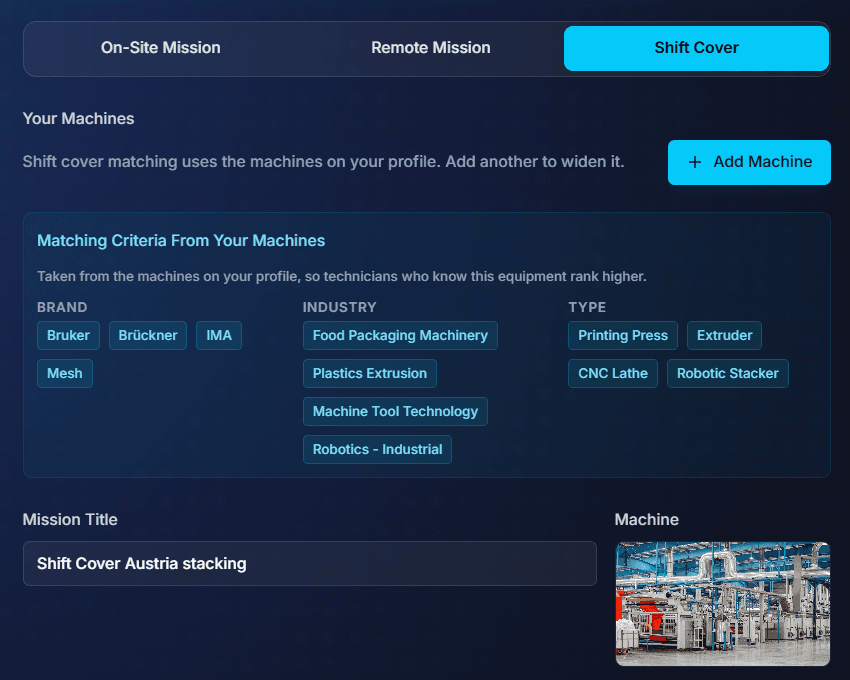
1. Choose Shift Cover
- No machine to select: cover is not tied to one asset
- Matching uses the machines already on your company profile
- More machines on your profile means a wider pool
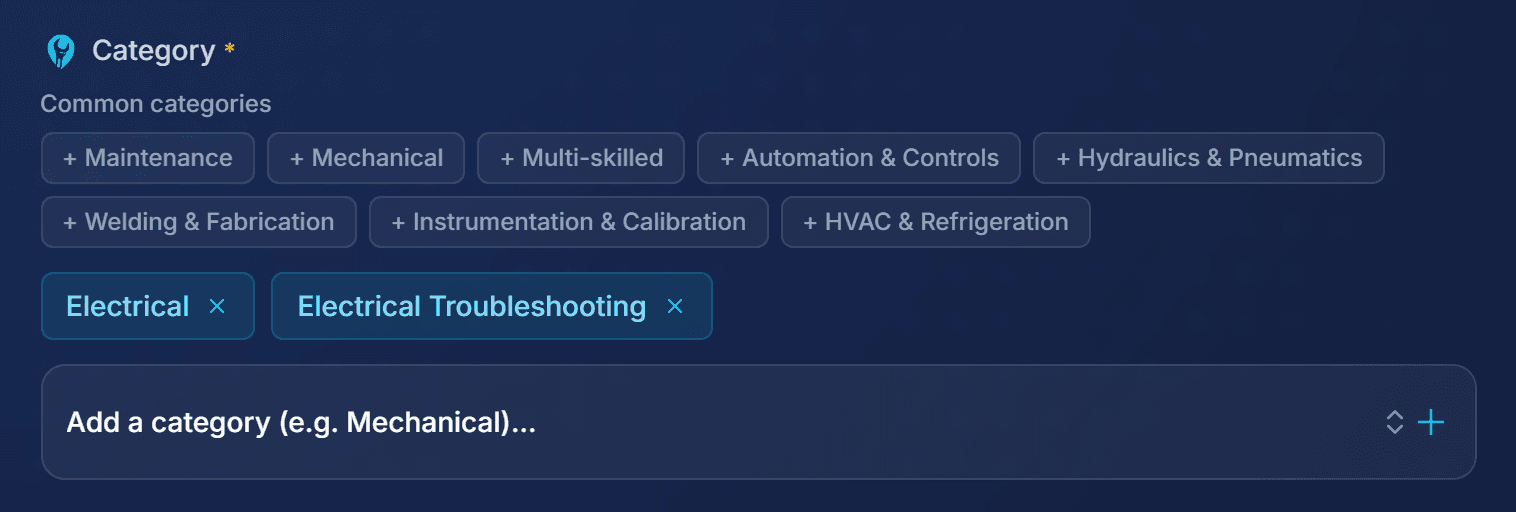
2. Pick the discipline
- Maintenance, Mechanical, Electrical, Multi-skilled
- Automation & Controls, Hydraulics & Pneumatics, Instrumentation & Calibration
- Welding & Fabrication, HVAC & Refrigeration
- One-click shortcuts, and you can add your own
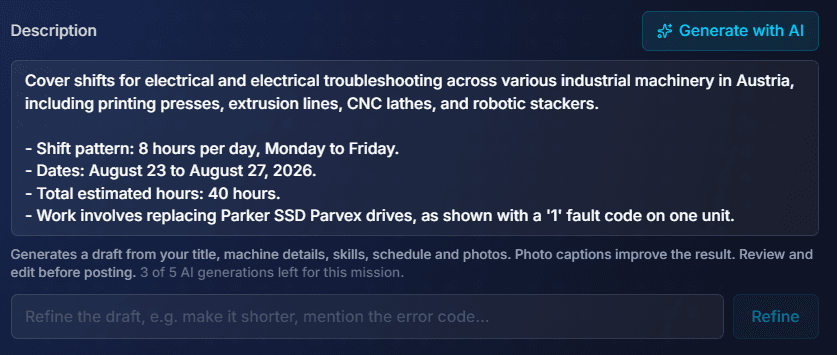
3. Describe the shift
- Shift pattern, equipment in scope, anything unusual about the site
- Draft generated from title, machines, skills and schedule
- Always edit it: this is what a technician reads before applying
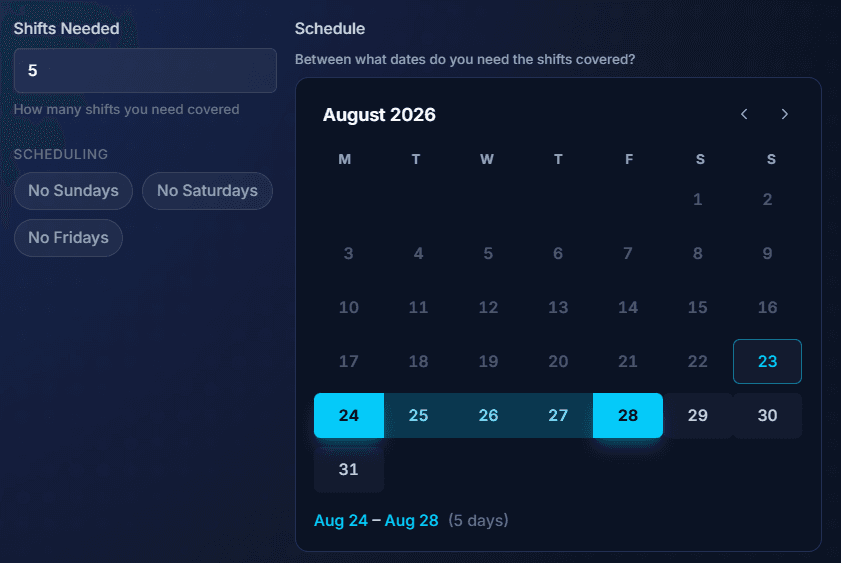
4. Set the shifts and dates
- Counted in shifts, not workdays
- That is what keeps a 12-hour rota priced correctly
- Friday, Saturday and Sunday exclusions available
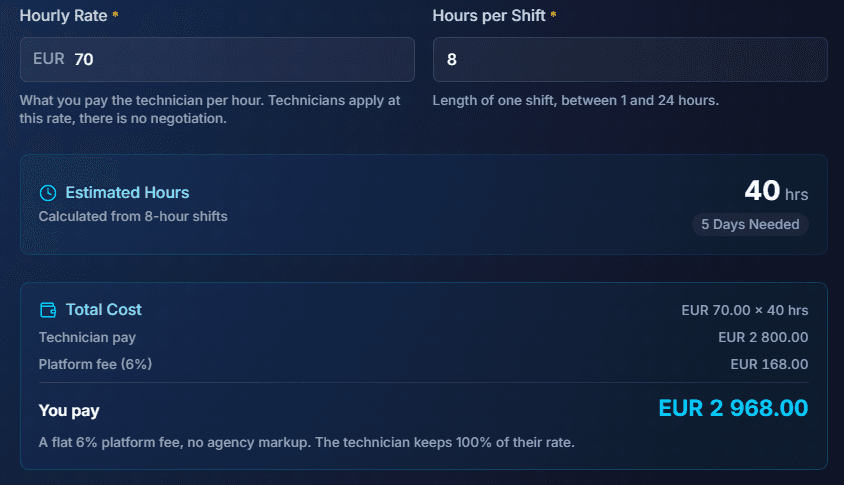
5. Set the rate
- You set the hourly rate and shift length, 1 to 24 hours
- Technicians apply at that rate. No quotation, no negotiation
- Total = rate x hours per shift x shifts, plus a flat 6%
6. Perks and site requirements
- Flag transport, hotel or canteen if you provide them
- Hard hat, hi vis, ESD and lock-out come from your company profile
- Set once, applied to every mission you post

7. Publish
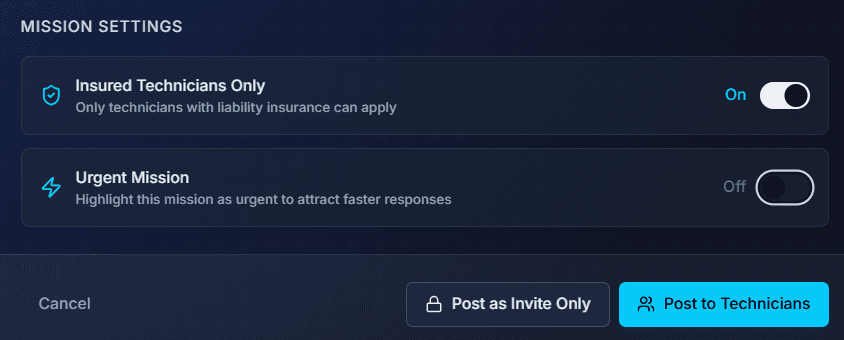
- Post to all matching technicians, or keep it invite only
- Restrict to technicians holding liability insurance
- Mark urgent when cover is needed at short notice (the platform fee is then 10%)
What Shift Cover Costs
6%
flat platform fee
- 3% payment processing + 3% platform
- Marking a mission urgent adds 4%
- Nothing else is ever added
- Charged on top of the technician's rate, so the technician keeps 100% of the rate you set
- Does not scale with headcount or mission length
- You set the rate at posting. There is no quotation and no counter-offer
- Total = hourly rate x hours per shift x number of shifts
- The 6% is paid by the company, so the technician receives 100% of your rate
- Agency margins are charged per hour worked and commonly run 25% to 50%
- A flat 6% does not grow with the length of the booking
Setting a realistic shift rate
- Nights, weekends and short notice generally command a premium
- A run of consecutive shifts is easier to fill than one isolated shift
- Rates vary widely by country and discipline: treat benchmarks as a starting point
Our European rates guide gives indicative ranges by country and discipline.
How Technicians Are Matched to Shift Cover
The FindFST AI Engine ranks the technicians. It scores each one from 0 to 100 against your shift cover mission and shows its reasons and gaps. You choose who to invite and book.
- Skills and the breadth of machine types covered lead the score
- A brand gap counts as minor, because the brands listed are the whole fleet at that address
- Distance never changes the score
- Location and discipline decide who is shortlisted, and the order you see before the scores arrive
Distance still matters for cover. Somebody has to be at the gate before the shift starts, every shift. A two hour commute you can put up with once becomes a reliability risk over a fortnight. So tag the discipline accurately and keep your machine list current.
Timesheets, Approval and Payment
- Payment is taken up front when you confirm, then the mission starts
- The technician logs hours shift by shift for you to approve
- Approved hours drive the final settlement, so short or long shifts change what you pay
- Each shift's timesheet can carry the technician's photos
- The technician writes a mission report as the shifts go on, and you receive it at completion
- Extra costs, such as parts bought on site, need your approval before they are added
The report covers the shifts worked. If you need a report on one defined piece of work, post a standard on-site mission instead.
How to Write a Shift Cover Brief
A cover technician is asking two things. Can I be there every shift? Can I deal with it when something breaks?
- Exact shift pattern and start times, including nights and weekends
- Whether the technician is alone on shift or part of a team
- What equipment is in scope, and what is out of scope
- Escalation: who to call, and what they can decide alone
- Permits, lone working rules, site-specific authorisation
- Handover expectations at the start and end of each shift
- Induction requirements, and whether the first shift is shadowed
Escalation is the one most briefs leave out. A cover technician who does not know what they can decide at 03:00 will either wake somebody up or wait. Neither is what you booked them for.
Disclaimer: This guide is provided for general informational purposes only and does not constitute professional, legal, or financial advice. All rates, timelines, and market data referenced are indicative estimates based on general market observations and may not reflect current conditions. Actual costs, qualifications, and regulatory requirements vary by country, industry, and project. Always verify information with relevant local regulations, obtain professional advice where appropriate, and request multiple quotes before committing to any engagement. FindFST accepts no liability for decisions made based on the content of this guide.
Cover Your Next Shift on FindFST
Book a shift electrician for a fortnight, mechanical cover through a peak or maintenance cover while you recruit. You set the rate and technicians apply at it.
Hire industrial field service technicians for shift cover and maintenance cover directly. No agency markup, just a flat 6% platform fee.