
Industrial shift cover technicians: Cover the Shift. Without an Agency.
- You set the rate
- Technicians apply at it, no negotiation
- Maintenance, electrical, mechanical or multi-skilled cover
- Flat 6% platform fee, technician keeps 100% of the rate
Hire industrial field service technicians directly for shift cover and maintenance cover. No agency markup.
How it works
Post the shift
- Pick the discipline
- Set the hourly rate and shift length
- Choose the dates
Technicians apply
- They apply at your rate
- No quotation, no negotiation, so a shift fills fast
Confirm and pay
- Approve an applicant
- Pay up front
- They log hours shift by shift, you approve them
Try it: post your shifts
- The FindFST AI Engine drafts the mission from the machines at the address, the categories and the shift pattern
- It suggests the requirements, you accept each one
The demo posts an example run of shifts. Click anything to take over, or switch tabs for the other mission types.
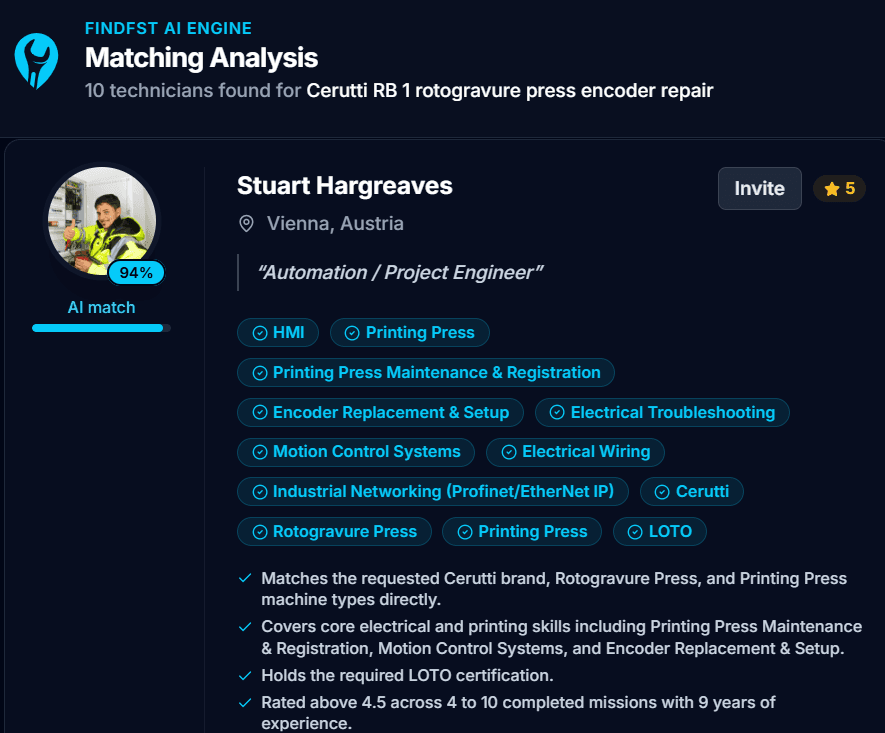
The FindFST AI Engine: a recruiter's work, done better
It does the matching a recruiter would, on every mission, across every verified industrial field service technician on the platform, with no CV pile, no phone calls and no agency margin.
Reads your mission
- Machine, brand, type, industry, skills, certifications
- Your priorities: what matters most, where you can compromise
Checks every verified technician
- Each profile is compared with what the work needs
- The best matches are scored 0 to 100
- Only structured profile data reaches the ranking, never free text: a well-written bio does not move the score
Shows its reasoning
- Every score comes with reasons and gaps
- Updates itself when the mission or a profile changes
- The score is advice: you choose who to invite and book
Keeps learning
- Each completed mission is logged against its match: score, rating, on schedule or not
- We measure and tune the engine against those outcomes

How a technician applies to shift cover
- No quote: they apply at your hourly rate and shift length
- Each technician picks the days they can cover, all or part of the run
- A technician can message you first to agree the days
The demo plays it through: the technician messages you, picks the agreed days, you accept.
From shift timesheets to the mission report
- Each shift logged: hours, notes, photos, on schedule or not
- The FindFST AI Engine suggests a description for each shift from its notes and photos
- The report shows the machines at your site
- The summary is drafted as bullets and refined in plain words
The demo plays two logged shifts through to the finished report and its PDF.
What it costs
6%
flat platform fee
- 3% payment processing + 3% platform
- Marking a mission urgent adds 4%
- Nothing else is ever added
- Charged on top of the technician's rate, so the technician keeps 100% of the rate you set
- Does not scale with headcount or mission length
Where the same £3,000 goes
£730 more reaches the technician than with a 30% agency, on the same run of shifts.
| Model | Fee taken | Technician receives |
|---|---|---|
| FindFSTflat 6% | £170 | £2,830 |
| Agency25% | £750 | £2,250 |
| Agency30% | £900 | £2,100 |
| Agency50% | £1,500 | £1,500 |
Illustrative figures, rounded.
- The FindFST row is £2,830 of shifts plus the £170 fee, paid on top
- An agency's margin comes out of the same £3,000
- Agency margins in industrial staffing are commonly 25% to 50%
How we keep it at 6%
The admin is automated, and there is no middleman to pay.
- Payments automated through Stripe
- Identity and fraud checks automated
- Insurance and certificates checked once
- No account-manager layer
- No recruiter commissions
- No branch network
When to use shift cover
Use shift cover
- A named rota position is empty
- Work is reactive and cannot be scoped in advance
- Presence needed across an area, not one machine
- Cover needed for a run of consecutive shifts
Use a standard mission
- One machine, one identifiable problem
- A specialist for a defined piece of work
- A written report on the intervention matters
- The work can be diagnosed remotely first
Kinds of cover
Maintenance cover
The general rota position: planned work when quiet, breakdowns when not
Electrical cover
A shift electrician for drives, controls, motors and power faults
Mechanical cover
Bearings, gearboxes, conveyors, pumps, hydraulics and pneumatics
Multi-skilled
One person across both disciplines, plus specialist categories
A worked example
Five 8-hour shifts at £70/hour.
What happens if there's a dispute?
Stripe holds the payment until the mission is complete, so a problem gets settled before money moves.
Open it in Mission Control
- Either side can open one once the mission is paid, during the work or just after it completes
- The mission pauses while it is open
Agree it between you
- Message each other, upload evidence and propose compensation
- An approved proposal settles automatically
Escalate if you cannot agree
- Either side can escalate: FindFST Support reviews the evidence and mediates
- Refunds go back to the original payment method
The demo plays a company disputing an unfinished mission, and the technician answering with evidence and a proposal. Click anything to take over, reject the proposal or escalate.
Common questions
How is shift cover different from a normal mission?
- A normal mission is a defined piece of work on one machine
- Shift cover is a rota position across whatever the site runs: no single machine, no photo needed to post
- The technician still writes a mission report
Do technicians send me a quote?
No. They apply at your hourly rate and shift length, with a written message.
Can I require insurance or certifications?
Yes.
- Restrict applications to technicians holding liability insurance
- Your site requirements carry over from your company profile
How do I pay?
- Payment is taken when you confirm
- Settlement runs on the approved hours, so a short or long shift is paid for what was worked
Other mission types
Fill Your Next Shift
Free to post. You only pay when you confirm a technician.